With a small number of plates stacking up I figured it was time to get some varnish work done. I am always a little hesitant, as I run the risk of fouling up a nice image by doing a lousy varnish pour. Practice makes perfect though, and I need the practice.
The big challenge for me is finding a relatively dust free environment. All looks clear, and clean until a warm, and very sticky film of varnish has been applied, then dust seems to come from everywhere.
Gum Sandrac, a tree resin, is the most common varnish used for this process. The resin is dissolved in everclear, and a little lavender oil is added. The oil acts as a plastisizer to keep the varnish flexible, and eliminate cracking.
The plate is first heated. An alcohol burner, or a hairdryer works well, the varnish is also warmed up to allow for a more even flow. It is very sticky, but also smells marvelous, a combination of frankincense, and lavender.
The plate then gets drained of excess varnish before being heated again to aid in drying. What little water that is in the everclear must be evaporated, or one risks the surface drying dull.
Into a w rack to dry, and cure. Drying time is not long, but it takes a few days for the varnish to fully cure.
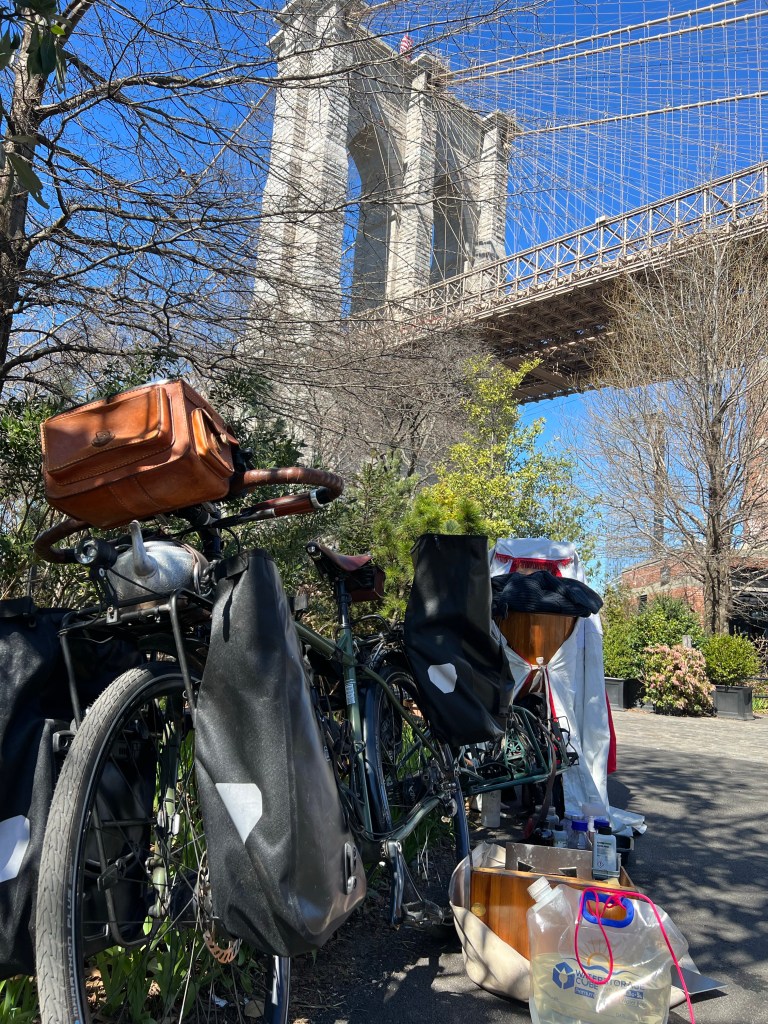
Calling for rain later today, and it feels it. Rather than spend the entire day indoors I opted to set our early to see about making a few tintypes. Loaded up the wagon, and headed for The Bridge.
This was both the warmest day of working with collodion, and by far the most humid. By the time I was set up I was soaked. My least favorite type of weather, but I needed to work in these conditions to get an idea of how it affects the wet plate process.
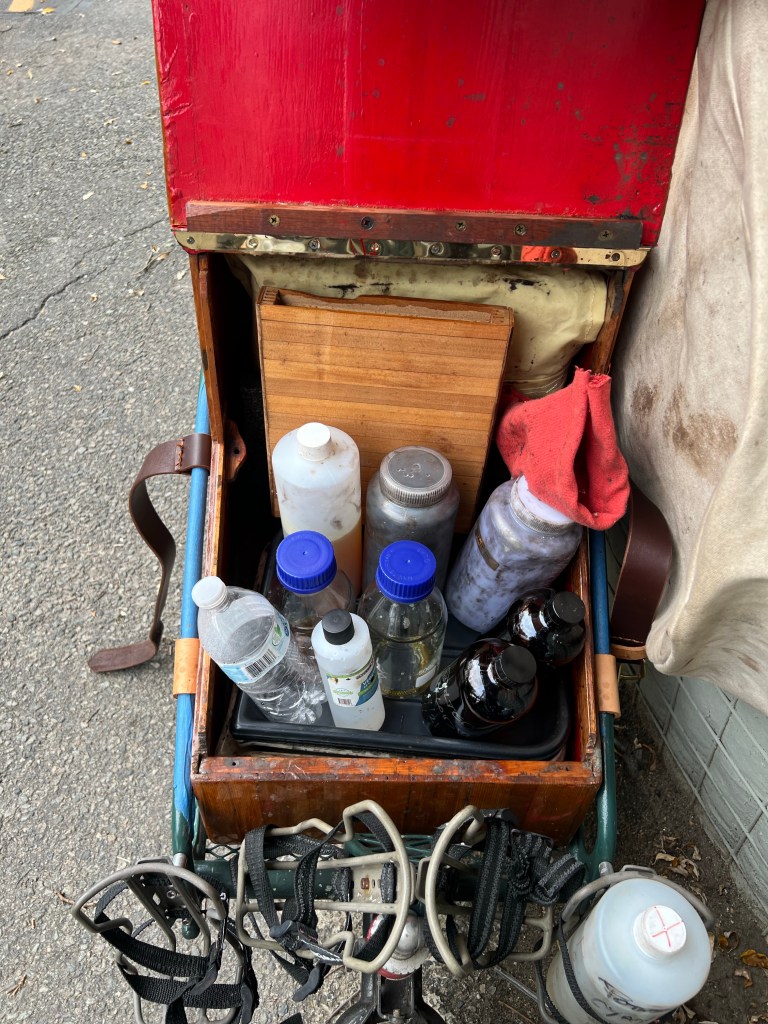
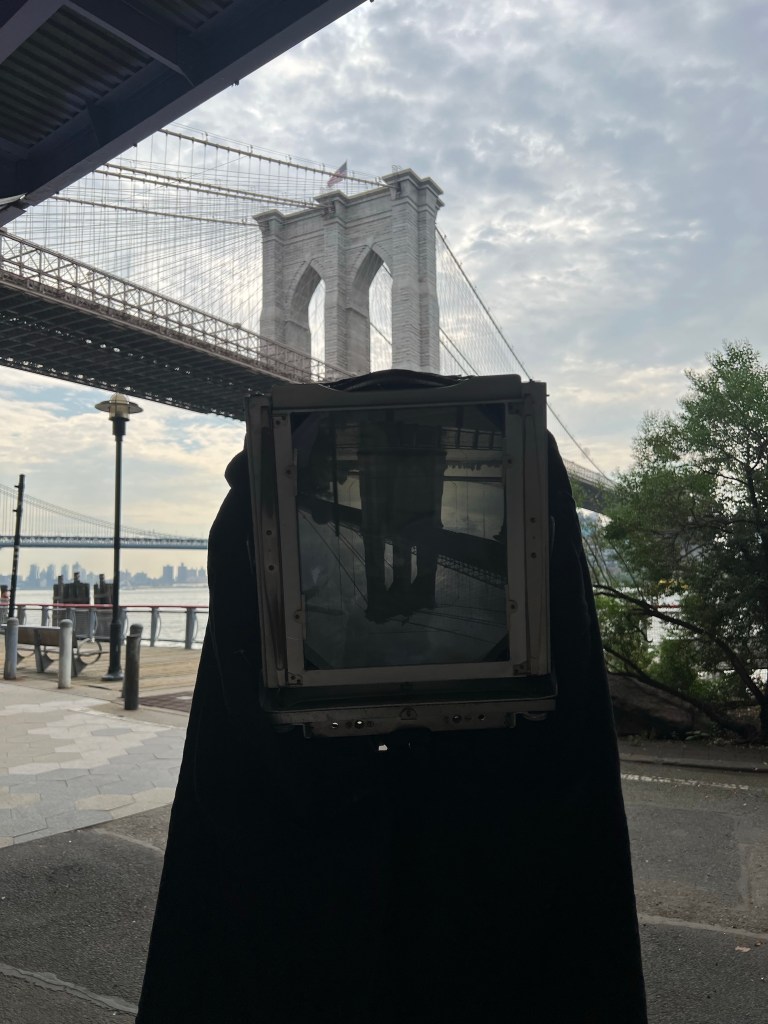
Arrived on site Unloading. Note that one bottle is not stored with the rest, but is secured outside of the box. This is the fixer, and in this case it is potassium cyanide, KCN. It must never get in contact with acid, so it is kept away from the developer, and the silver bath.My labComposing the shot. At f16 I estimate the exposure to be about 10 seconds. Let’s see how that works.
The collodion gets poured onto the plate, then is placed into the bath of silver nitrate where it will remain for 4 minutes. This is the step that makes the plate light sensitive.
Once the 4 minute mark has past I then, under safe light, load the plate into the film holder, and then to the camera for exposure. 10 seconds.
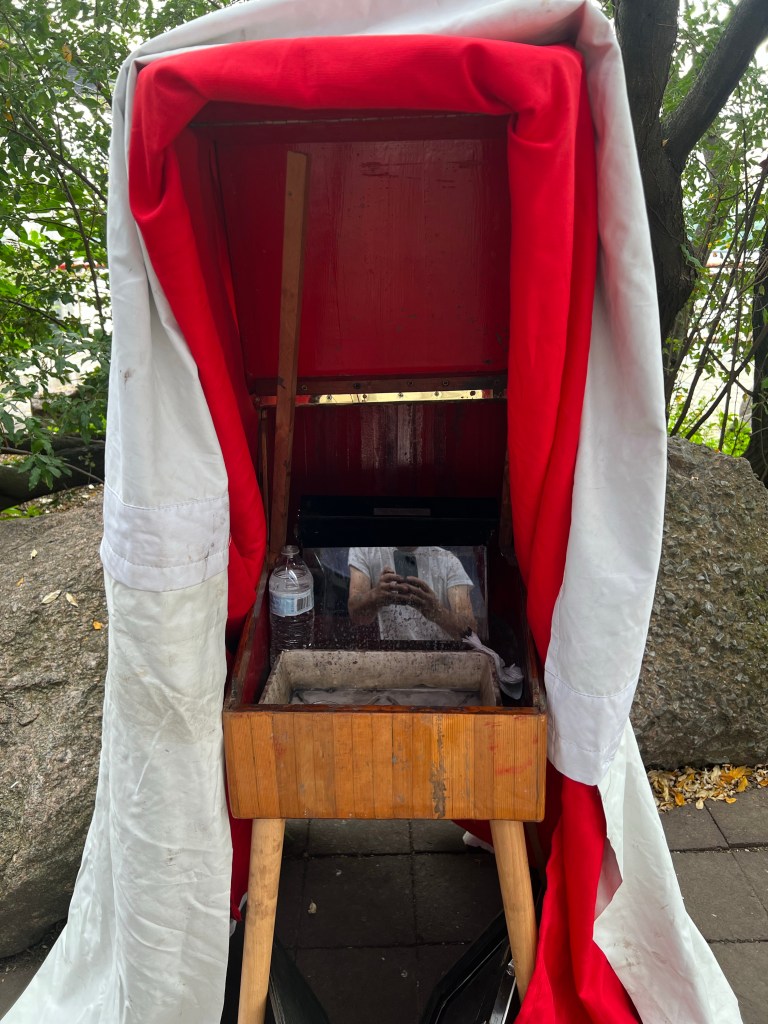
Back to the dark box, which is not really all that dark as I wear a red headlamp for illumination. Remember, the plate is only sensitive to Ultraviolet light.
Developer is poured over the plate, and slowly an image begins showing. Highlights at about 5 seconds, and shadows at about 10, to 12. Water is poured over the plate now to halt the development process. At this point the plate is no longer light sensitive, and can be brought into the daylight for fixing.
Fixing a plate is always magical
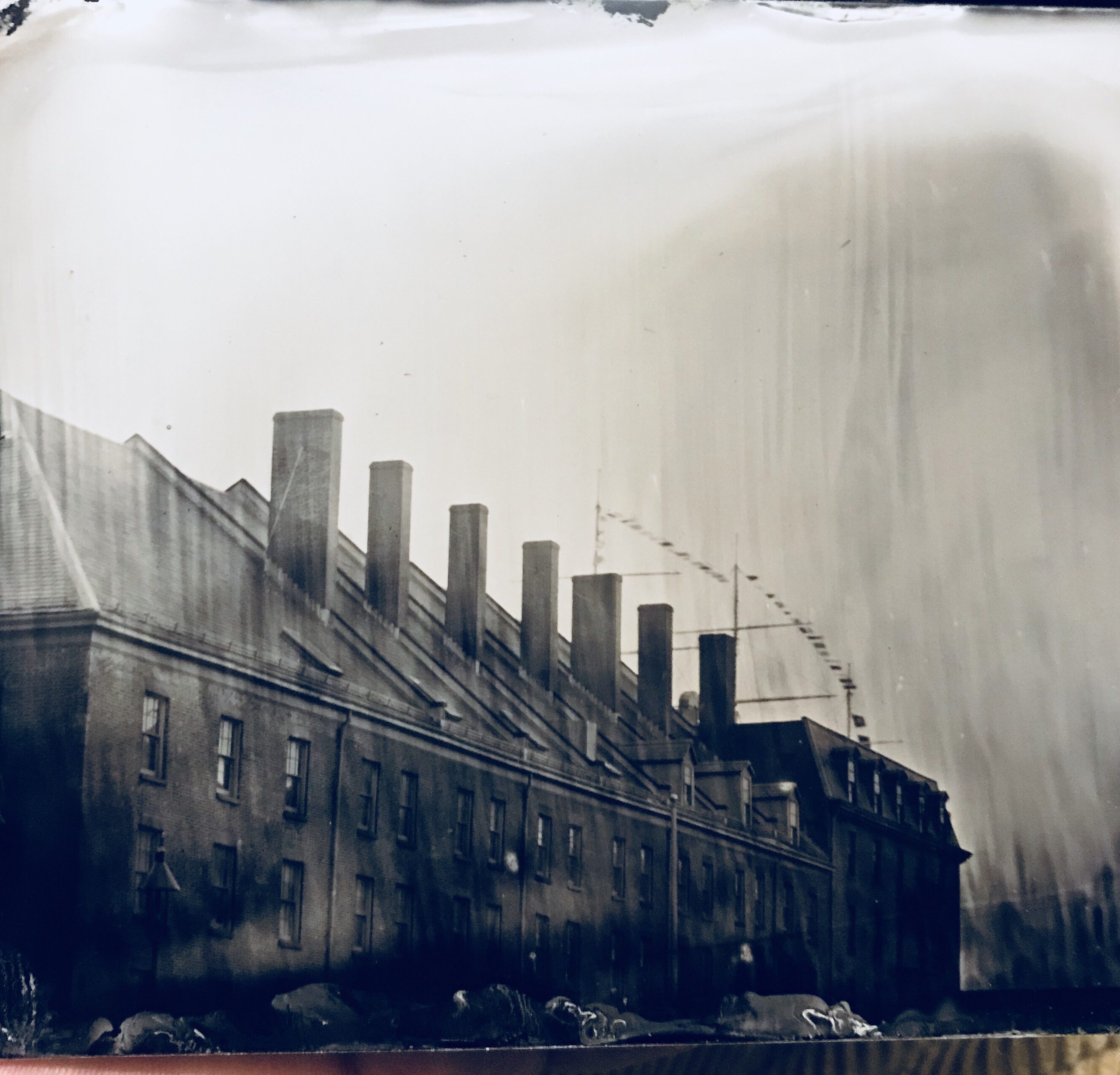
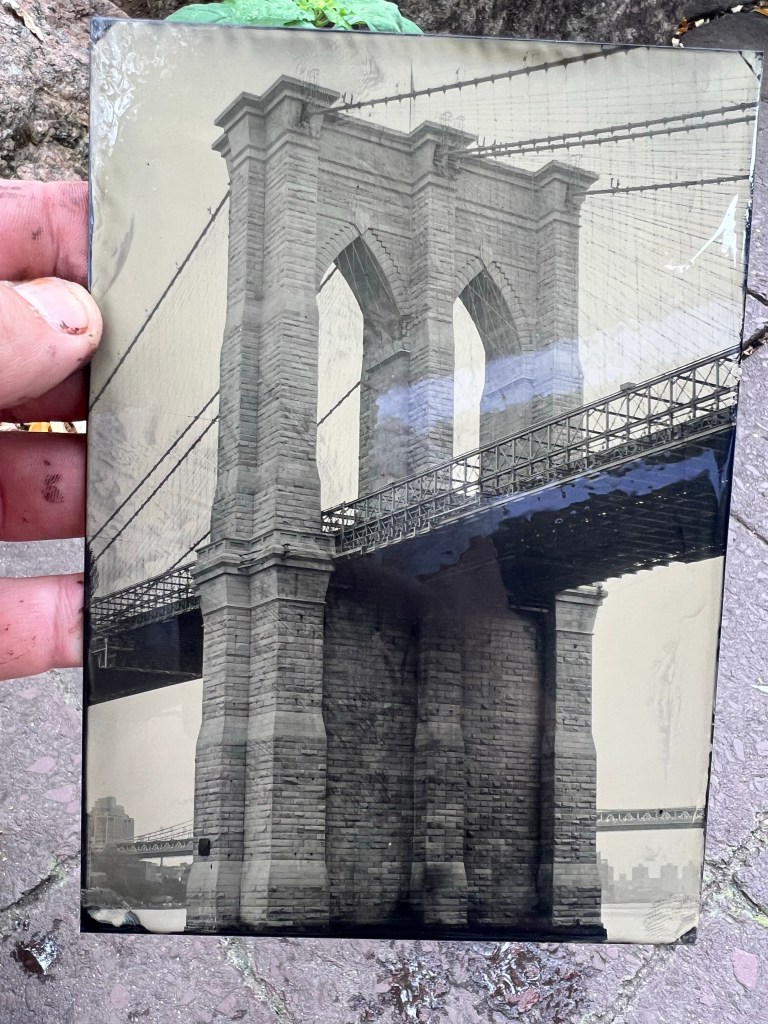
My test plate was spot on for exposure. I next made an ambrotype, seen in the above video, and then a few 8×10 tintypes.
A beautiful subject
I was not happy with the weather, but very pleased with the images I made this morning. Once they have dried I’ll get them varnished, and if I don’t mess that up I’ll post them.
Felt a little sluggish this morning. I wanted to take advantage of the early morning light along with the cooler weather, but did not want to deal with the bicycle hookup. I compromised by just loading up the trailer, and hauling it down to the end of the pier.
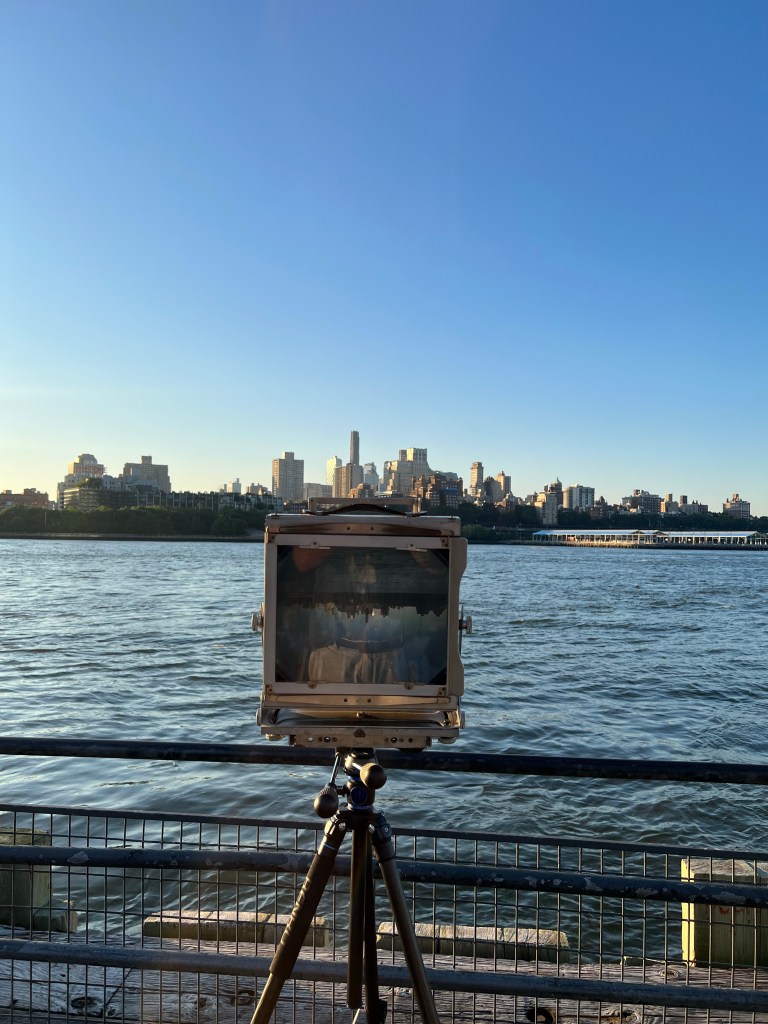
A nice little breeze off the water felt nice. Both the camera on the tripod with it focusing cloth, and the dark box with the cloth hood are at risk of blowing over, so I secured them both before proceeding.
View of Brooklyn
The set up process is rather automatic now. I have made a conscious effort to do things in the same order, and to both talk to myself whilst doing it, as well as physically point at the bottles of chemicals as I set them out. This, I hope, will lessen the chance of handling the wrong chemicals in the wrong way. Acid, and KCN= death. Don’t want my last words to be oops.
Packing up is the same process in reverse. I learned this years ago on one of my first bicycle trips. Pack your panniers the same way each time. This makes it easier to locate items easier, and lessens the risk of leaving something behind, like all your tent pegs!
The morning shoot went well. The fixer is slowing down, and will soon need to be replaced. I’ll need to neutralize it before disposing, then filter out the silver.
I have, over the years, managed to collect a rather sizable number of cameras. 35mm, medium format, 4×5 box cameras, and a number of speed graphics. I was twenty four when I purchased my first speed graphic camera. I actually bought two at the same time out of the back of a car in the parking lot of Renys in Camden Maine. The seller was a retired Bangor daily news photographer who was downsizing his collection.
I sold one of the cameras, and then set out to learn about large format photography. I hauled that camera around everywhere, including a trip to Patagonia.
A few years ago I gave it to a friend who was looking for an inexpensive 4×5. Then, years later I ended up with two more. The most recent one once belonged to a police department in Connecticut. Beautiful condition, dozens of film holders, and flash bulbs.
I used it a few times, but soon realized it was just sitting on a shelf most of the time as I concentrated on my wet plate photography, and my 8×10 camera. It really needed a new home with someone that would fully appreciate it.
Up for sale on eBay. Local pickup. About an hour ago I handed it over to the new owner. First time in decades with out a graphlex camera. A little sad till I had the chance to talk with the new owner, and then I knew it was the right thing to do.
It has been awhile since my last post, and wet plate work. Other things to do, and the hot weather has kept me away.
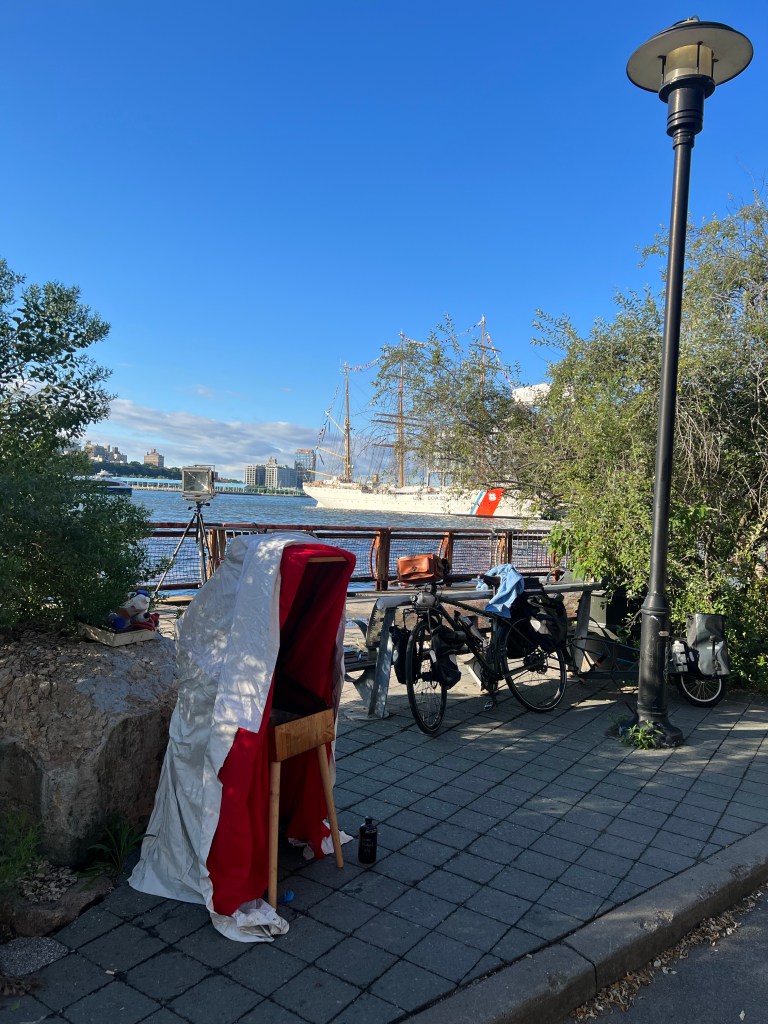
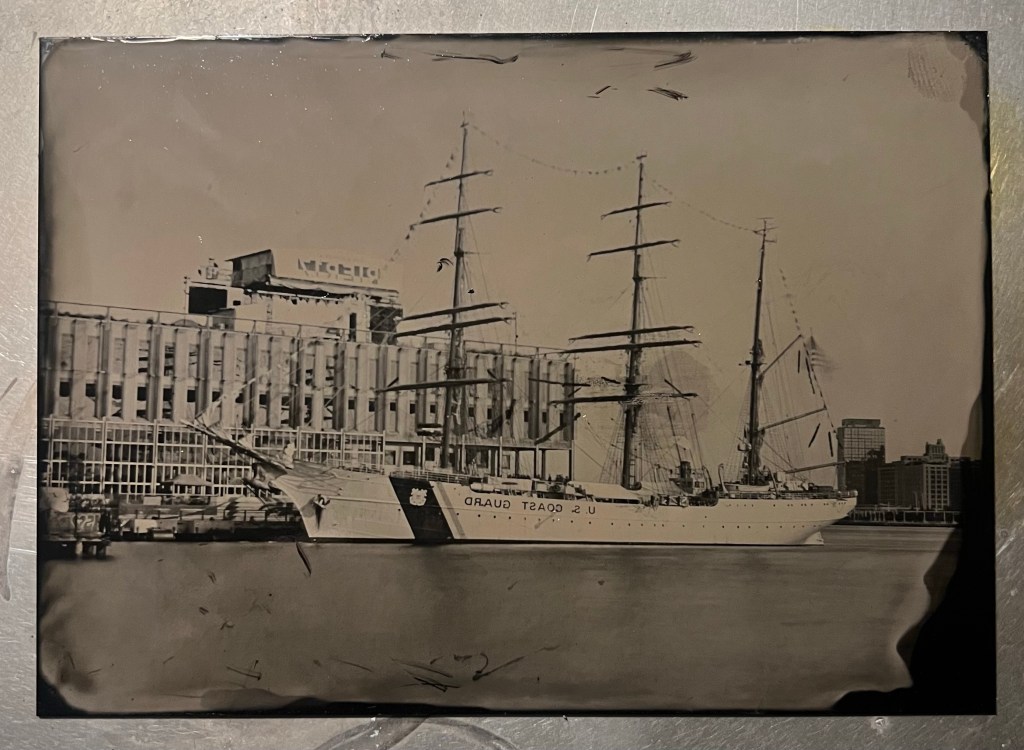
Awoke the other morning to temperatures in the mid sixties, and decided it was high time I got my gear back out to make a few tintypes. I was fortunate in that the barque Eagle had arrived the day before, and was in a good position to be photographed.
A few minutes to set up, compose a shot, I’m good to go. Near perfect conditions for wet plate work. Plenty of UV light. Warm, but not insufferably hot temperatures, and a rather nice subject to capture.
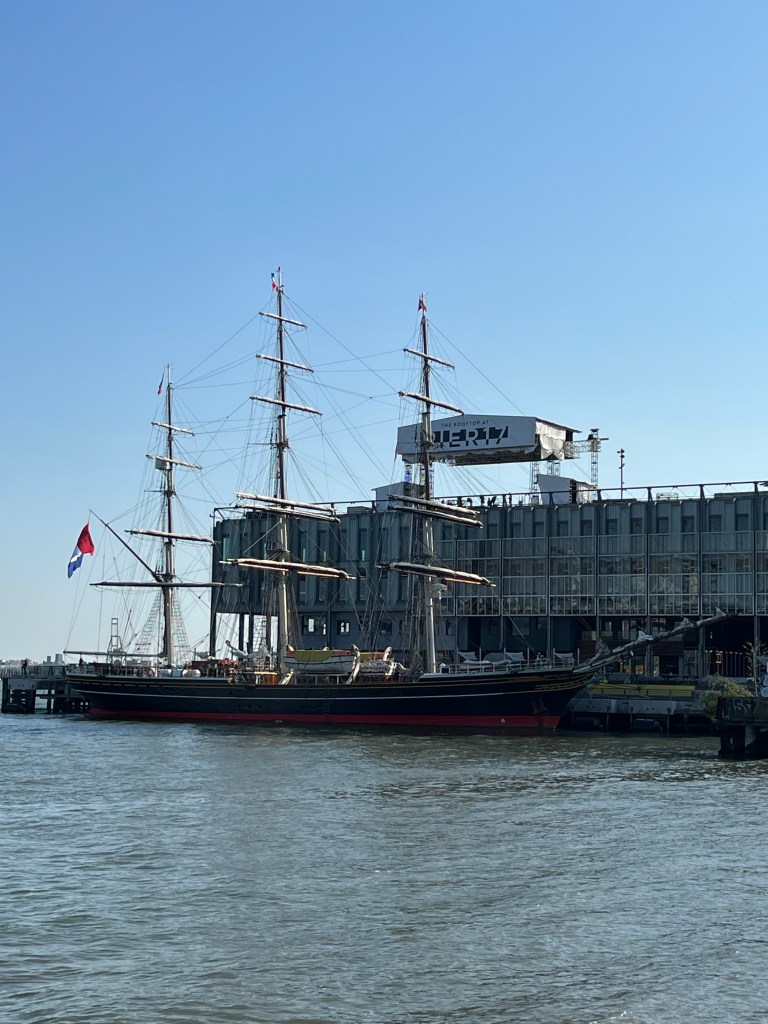
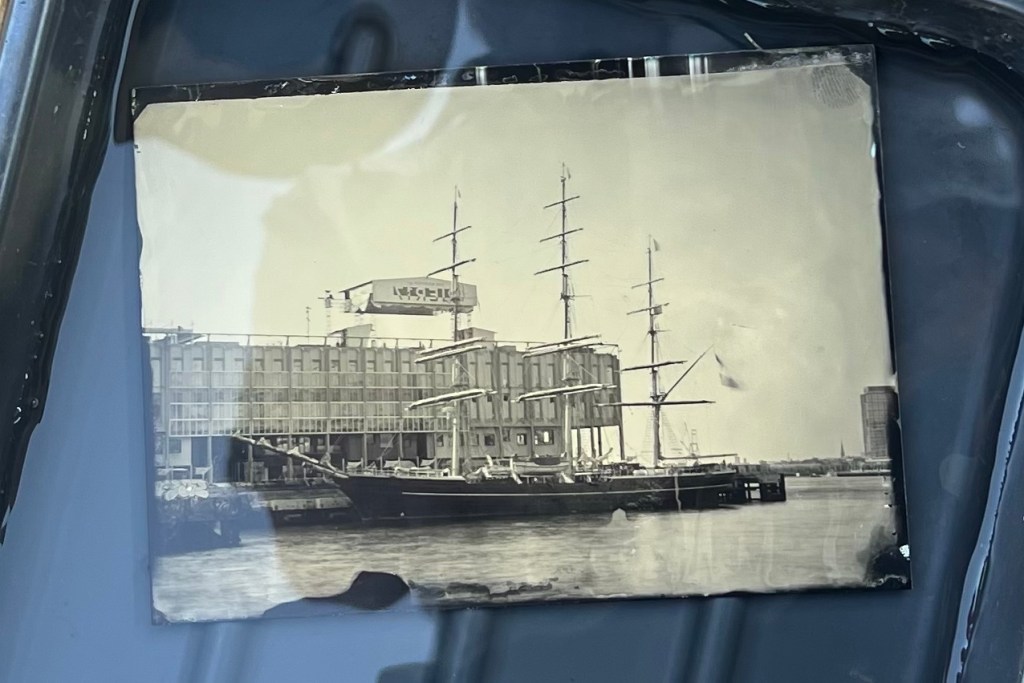
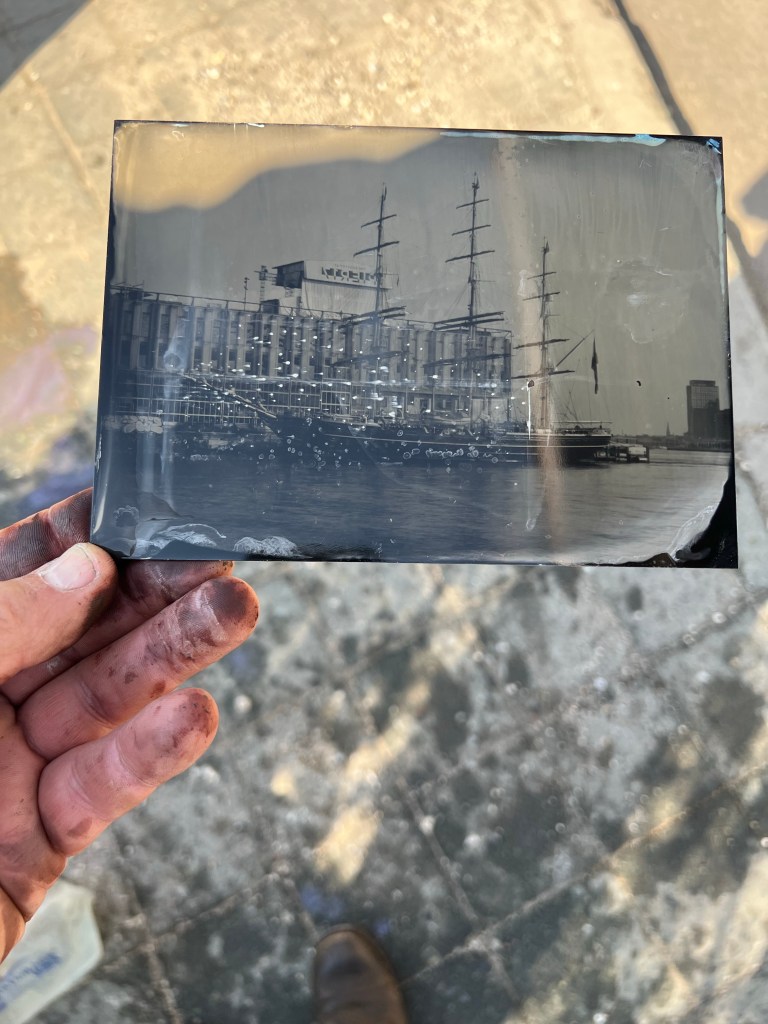
The sailing ship Stad Amsterdam came into port the other day, and is berthed on the neighboring pier in the seaport. I managed to get a decent tintype yesterday, and set out early this morning to see about getting a few more.
I went to do a second plate, but noticed a grainy look to the collodion when I poured it on the plate. The first plate seemed fine, but the next two showed signs of contamination.
Not much I can do but pack up the show, and head back to barn. I’ll filter the hell out of the collodion, and hopefully that will solve the problem. I’ll also take advantage of this sunshine to clear out the silver nitrate.
The good one.
Well, it’s too nice a day for staying in. Perhaps I’ll go see the cherry blossoms at the Brooklyn Botanic Garden.
The past few days here in The City have been well into the upper eighties. A bit early for me, but next week looks to be more seasonable. Humidity is low which is a blessing.
The wet plate process, like myself, does not like high temperatures. The ether begins to boil at around ninety degrees, and can become dangerous to work with, so I headed out early to get some plates done before the mercury rose to the danger zone.
My goal was to make some negatives, and I had spent a few minutes the day before getting some 5×7 glass plates squeaky clean. Nothing so frustrating as putting a developed plate in the fixer, and seeing the colloidian slide off in one sheet simply because of poor plate preparation.
I was pleased with the results, and hope to make some prints with this negative. Need to save up $$, so I can purchase some platinum/ palladium. The war in Ukraine has driven the prices sky high. In the meantime I’ll do some salt prints.
Awoke this morning to the sound of rain, brewed a pot off coffee, and planned my day.
Nothing pressing, so I poured another cup, and enjoyed the solitude of an early start.
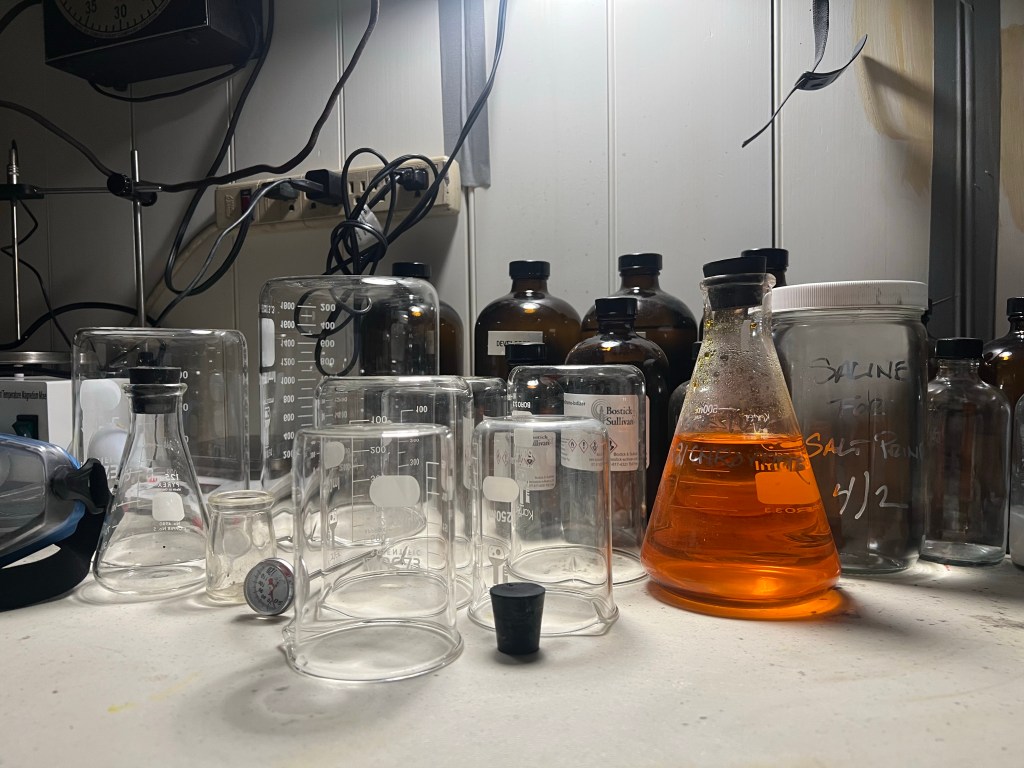
Breakfast dishes done, and put away. Time to find a project. A good day to get in the dark room,, and sort through stuff. Time to toss a few expired chemicals, wash some beakers, flasks, and test tubes, and give everything a good cleaning.
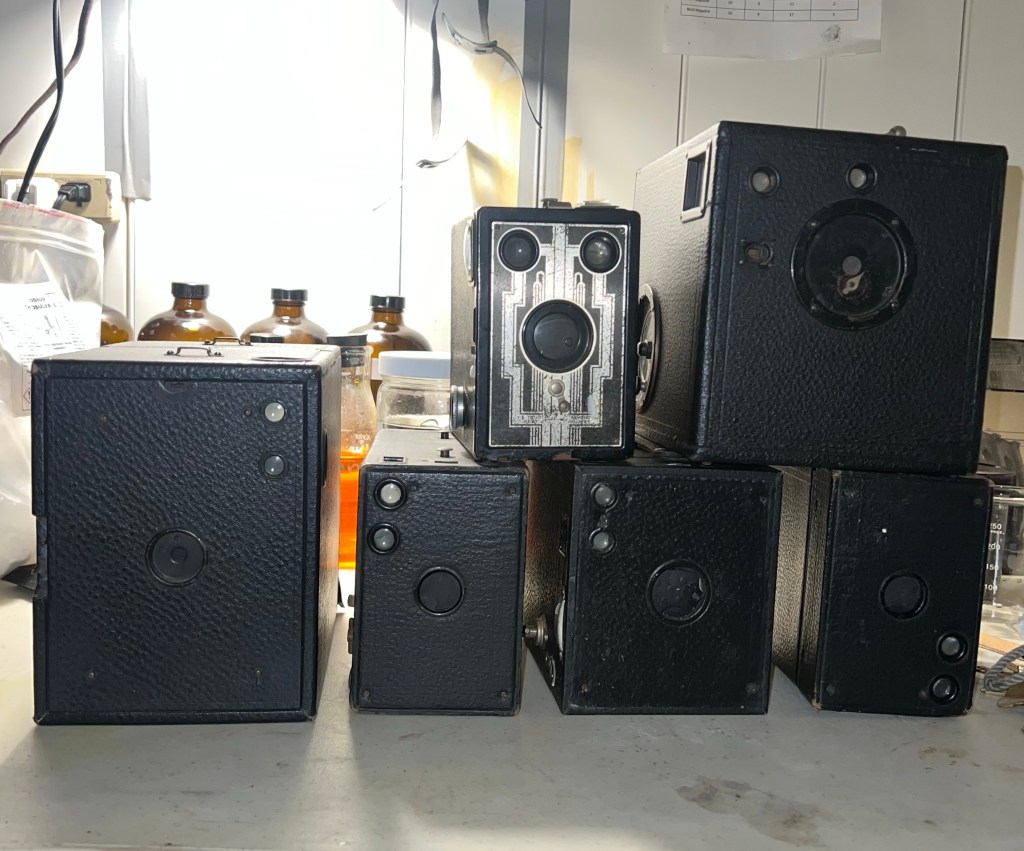
I also took stock of my camera collection. Some of it I have not used in years, and a few not at all. I am now at the point in my life when I need to downsize. Devote myself to photography, and not camera collecting.
Vintage box camera collection
If I can’t carry it on my bicycle, then it has to go.
Well, the morning organization went well, so now time to do some printing.
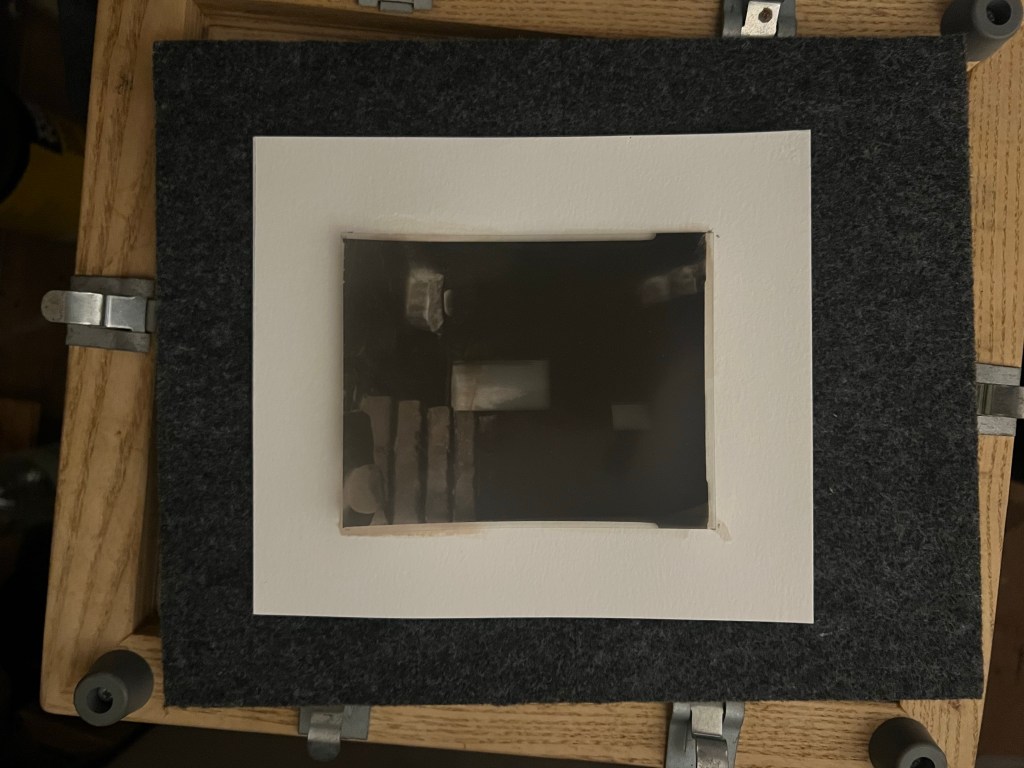
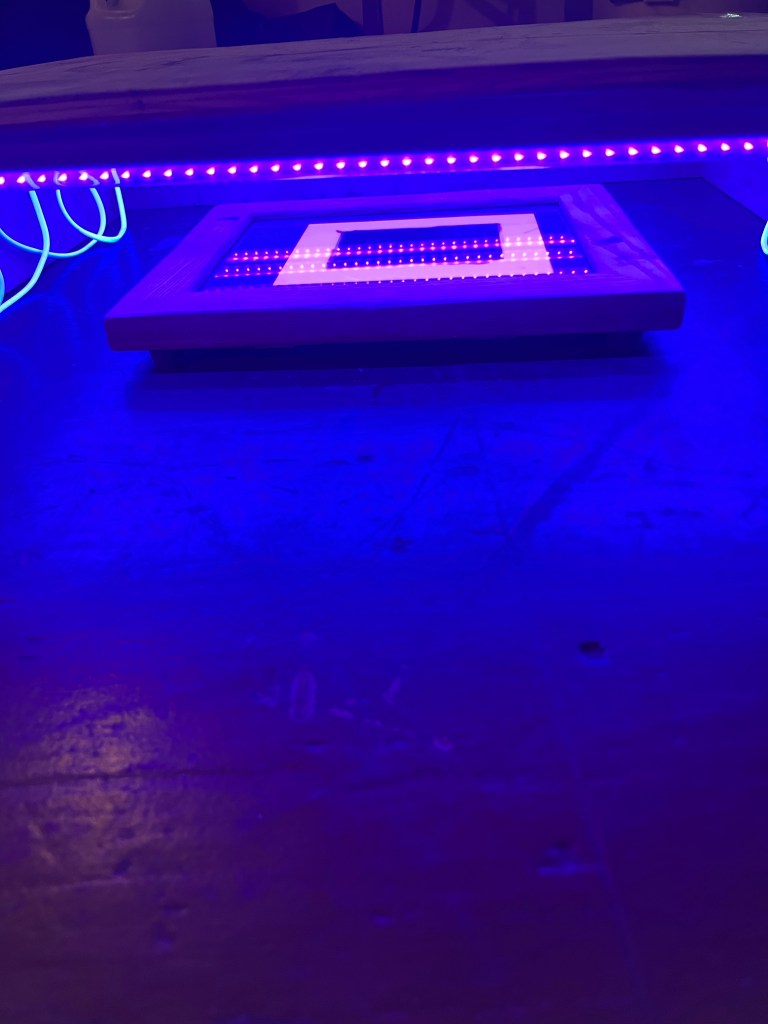
A simple salt print begins with saltInto the holder, then under the UV lamp
Two prints to start. A 4×5, and a 2 1/4 x2 1/4
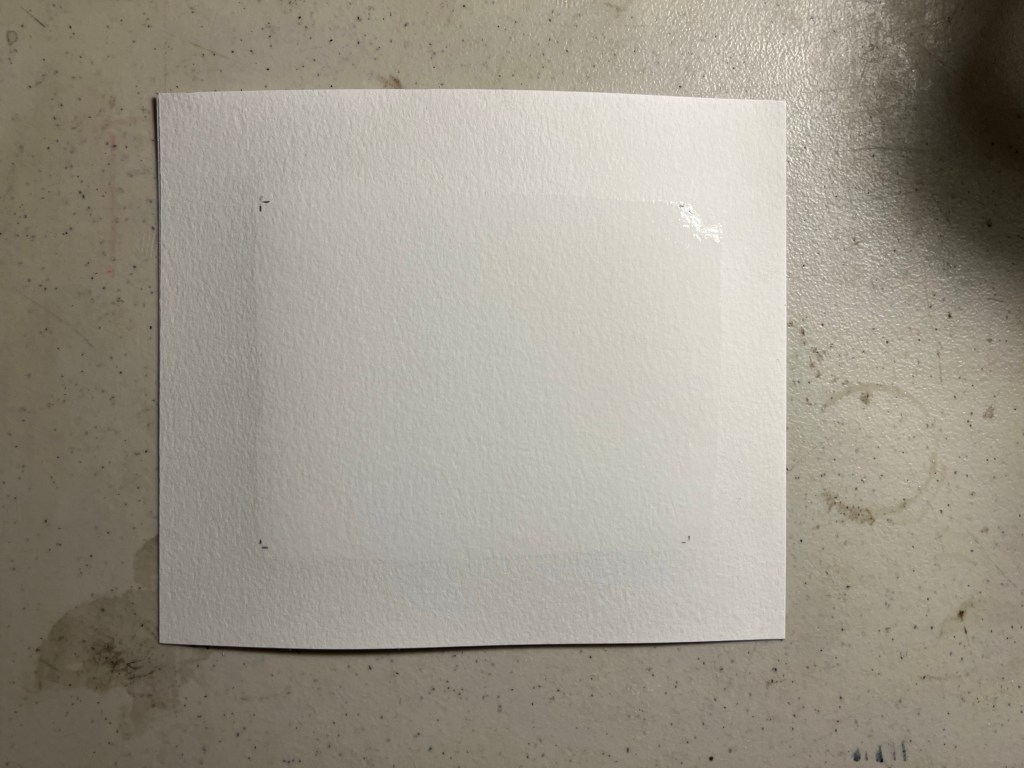
Salt printing is about as easy as it gets. Water colour paper is first coated with a simple saline solution, and allowed to dry before being coated with a silver nitrate solution, and dried again. Now the paper is light sensitive.
This is a contact printing process, so a suitable sized negative is selected, placed on the paper, and exposed to UV light. On sunny days it can go outside, but today is overcast, and wet. Under my homemade light box then.
Eight to ten minutes does the trick. Now a quick rinse under cool water before washing in a bath of sodium thiosulfate, and then a final bath.
I have thousands of negatives. 8×10, 4×5, 5×7, medium format, and 35mm. Most have never been printed, and I am only now just beginning to scan them. But, I’m only Sixty Two, and I can save that for when I’m old.
Yesterday’s wet plate adventure was just about the most frustrating in a long time. Nothing was working as expected. I made the decision to get up early again the following day, and try again. I suspected that part of the problem was the cold weather, and the effect it had on the developing. I kept my chemicals in a warm room for the night, and in the morning I filled my bottles with warm water before heading out.
I was not planning on going far, as all I hoped to accomplish was getting a decent plate. So, off to my testing area by The Bridge.
Whilst setting up I had a nice chat with two delightful women who were on their way to an art show. I answered questions about the process, and showed them a plate I had varnished a few days before. I really do enjoy talking with people about this fascinating process. I remembered to bring business cards too!
A bit warmer than the day before, felt nice in the Sun. Once I was set up I poured a test plate, put it in the silver bath, and set my timer for four minutes.
Out from the bath, into the holder, and then over to the camera. I estimated an exposure of about two seconds at f16. One one thousand, two one thousand.
Back to the dark box for development. If the exposure is correct I should start seeing an image around the ten second mark, and was tickled pink when it happened. A few more seconds, and the water is poured over to stop development before going into the fixer. When washing at this stage you are looking for the water to run off smoothly. If it looks greasy then it gets a another rinse. This is not only important for stopping the development, but also to remove any remaining developer, which is acidic, before putting it in to the fixer, which is potassium cyanide. Keep acid away from KCN!
Once the plate is clear of developer it can be brought out into daylight, and placed in the fixer. The cyanide works much faster the other fixers, only a few seconds, and I feel it creates a nicer image.
The fixing step is so magical. Never tire of seeing an image appear. Even better when it turns out nicely.
Fixing
I was so happy to see this plate. It more than made up for all the frustration of yesterday. I played around a little more. Shot a few 8x10s then called it a day. Forecast is calling for a few days of rain. Will take advantage of that, and get some plates prepared for some ambrotype work. Be well.
I awoke this morning a few hours before the Sun. Looked at the thermometer, and decided to brew a large pot of coffee. Temps below freezing, and it did not look as though it would warm any time soon.
I had loaded up my trailer the night before with hopes of getting an early start, but I’m in no rush to get out till the Sun is up. More coffee.
Still on the cool side at 0900, but times a wasteing, as they say. I stopped for a moment where I usually set up near the Brooklyn Bridge, but decided to push on, and find another spot.
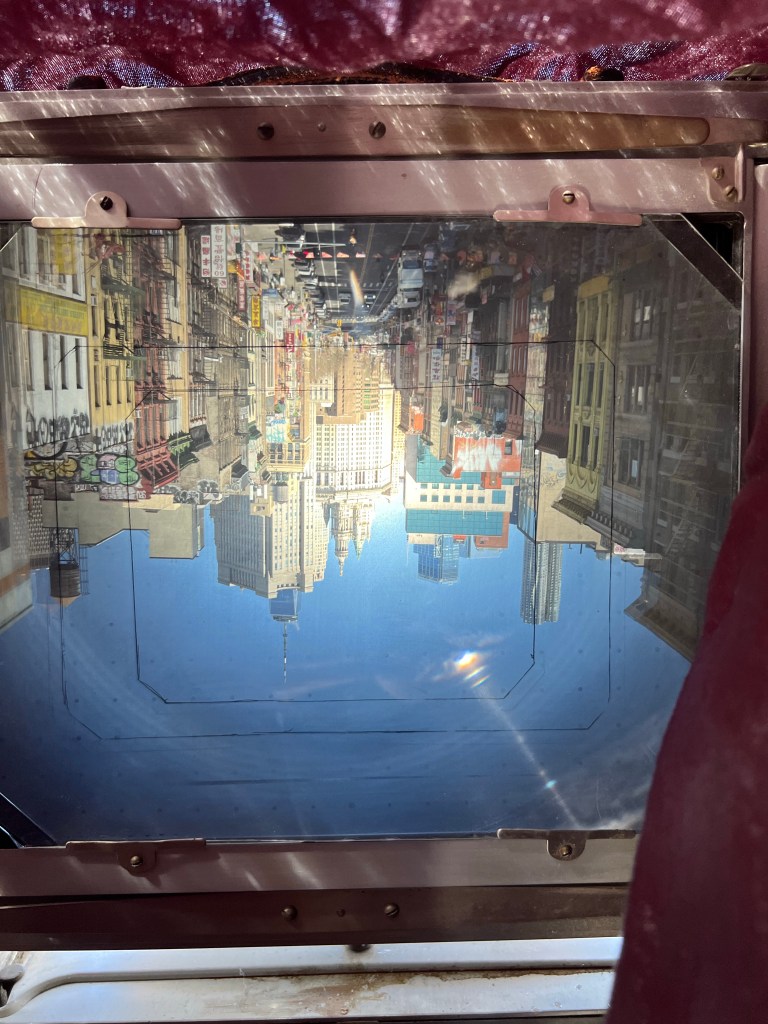
View of glass under dark cloth.
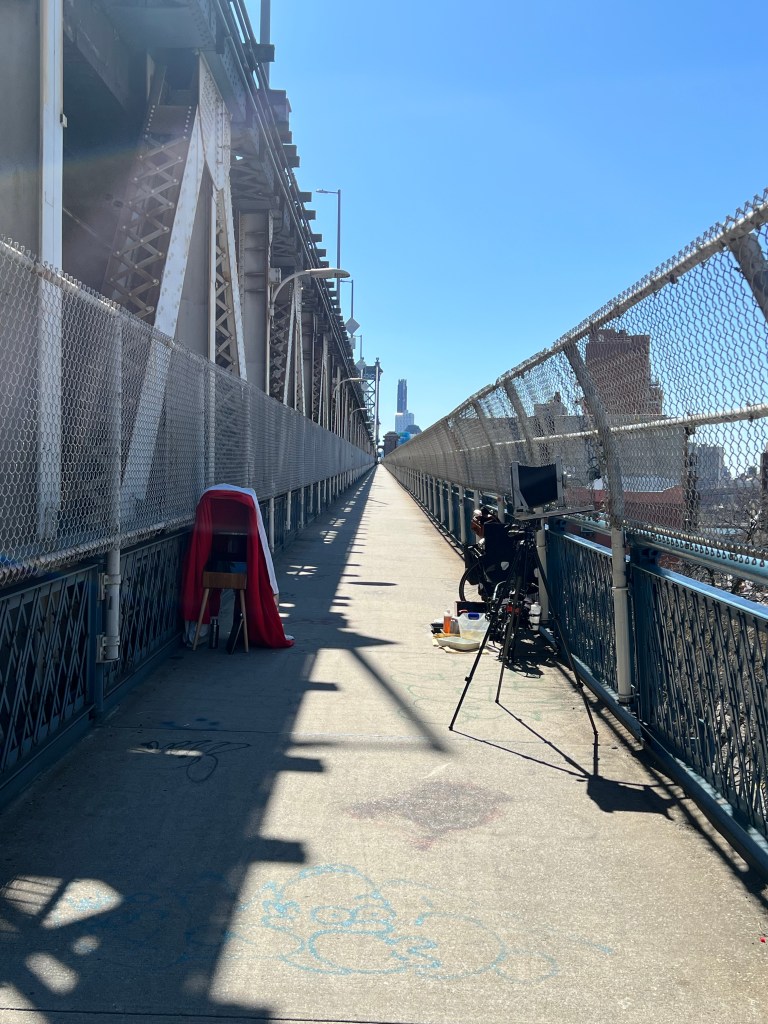
I made my way to the Manhattan bridge. Walked my bicycle up the pedestrian path to find a spot overlooking Chinatown. Still chilly, but the Sun was bright.
My first plate, a 4×5 used as a test, was slow to develop. I adjusted my exposure time, but was still not happy. It also looked a little blurry, so I popped my head under the cloth to have a look. Seems fine.
Ignore the bad pour marks
My next two plates had the same problem, and the I realized that it was the vibration of the bridge whilst the train was passing over!. Lesson # 1
I crossed over to Brooklyn to set up on terra firma with hope of getting a decent tintype. It was warming up, but not by much
Old subject. New angle.
Set up off to the side along a busy sidewalk. Had a nice chat with a few of the park rangers who were curious as to what I was doing. Once they realized I was not a homeless individual, or running a mobile meth lab, they smiled, and went about their business.
More test plates, one after the other, and still not pleased with the results. Adjusted my exposure time, but still the development time was off. I scratched my head for a bit, caught my reflection in a small puddle of water, and noticed a little rim of ice around the edge. Temperature! That’s the problem. I had loaded my bicycle the night before, and the jugs of water, and the bottles of developer were chilled below recommended temperatures. What I assumed was exposure time’s causing slow development was in fact just very cold chemicals. Lesson # 2
During the whole morning of shooting I was pleased to chat with several individuals who were interested in what I was doing. Even the less than perfect plates still seem to amaze people. I always enjoy explaining the process, and if someone has the time then I am more than willing to walk them through the whole process. I was ask several times if I had a website, or a card. A few days before I was cleaning out my handlebar bag, but neglected to put my business cards back. Lesson # 3, keep a supply of cards with you.
Not as productive a day as I hoped if I judge it by the tintypes, but very productive if I remember the lessons I learned.


 Webster’s Wet Plate
You must be logged in to post a comment.