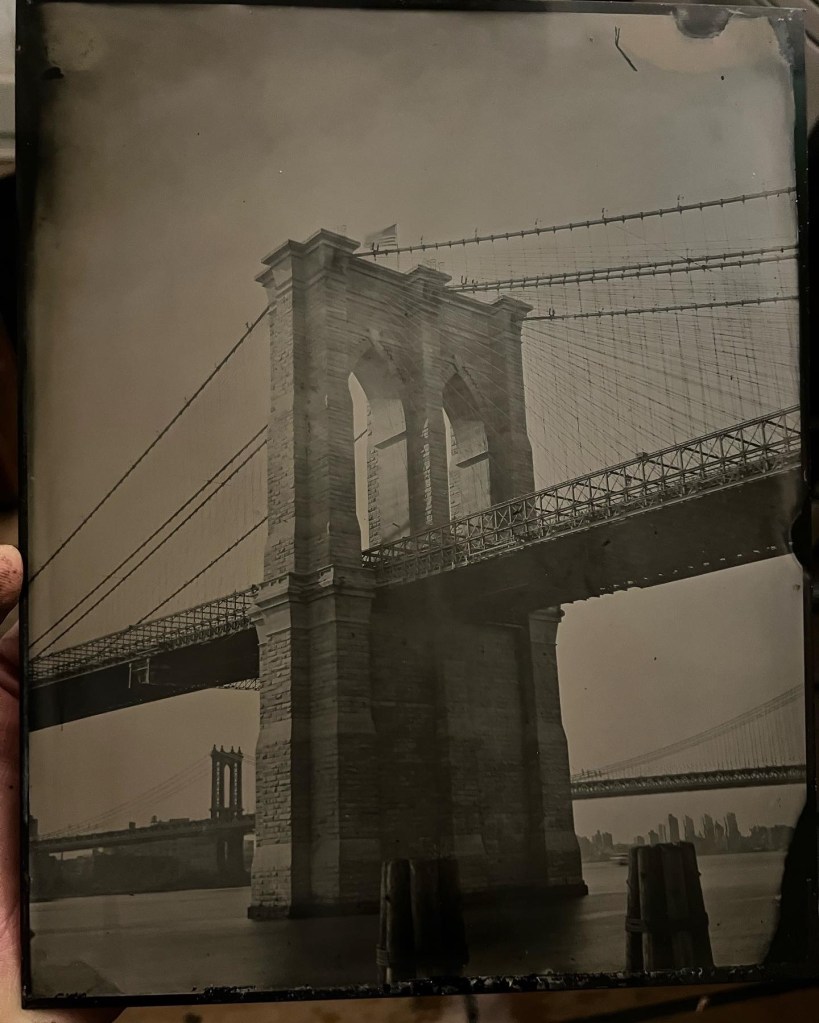
I had read somewhere that the Brooklyn Bridge is one of the most photographed man-made structure in the world, and makes up a bulk of the images in the library of Congress. Certainly, when one sees the masses of tourists walking across at any given time, all with phone in hand to capture a selfie with the bridge as a backdrop, it is not difficult to imagine, but the Brooklyn Bridge’s fame as a photographic subject goes way back before the iPhone.
The wet plate colloidian process, which I use to capture images of the Great Bridge, goes back to the early 1850s. As the construction of the bridge began around 1869 it was certainly photographed during its construction. The photographer would need to have hauled their darkroom down to the shore of the East river, exactly the way that I do, though probably not with a bicycle, and certainly not the comfort of a promenade to work from.
The camera would be set up, image composed on the ground glass, and then the plate prepared, exposed, and developed. Any onlookers would have been thrilled, and amazed to see the image appear like magic as it is placed in the fixer, a weak solution of potassium cyanide.
Few individuals had the wherewithal, or the time to devote themselves to this process. Though not overly complicated it was laborious to haul all that gear around. Believe me.
Then around the 1870s a huge advancement was made in the photographic process. The dry plate was perfected. Now all one needed to do was load a few plates with pre coated emulsion, stroll down to the Bridge, and snap away. No more lugging all that equipment around. Just walk home, pop into the darkroom, and presto you have a glass plate negative.
With this negative you could now make endless prints, or photographs. You could now call yourself a photographer, as opposed to a tintypist, or ambrotypist, depending on your choice of plates.
The wet plate colloidian process would not completely vanish for some time, it would continue on at fair grounds, beachfront amusement locations like Coney Island and the like.
In this age of instant image capture, and sharing where someone that lives thousands of miles away can see what you are eating for lunch, and that’s ok, I have seen some beautiful pictures of crabmeat sandwiches, and curly fries that have made my mouth water, but it is not magical. Not like when the plate is brought out of the darkroom, and placed into the fixer. The faint negative image seems to vanish, and then slowly reappears as a positive. Never get tired of seeing this.
 Webster’s Wet Plate
You must be logged in to post a comment.