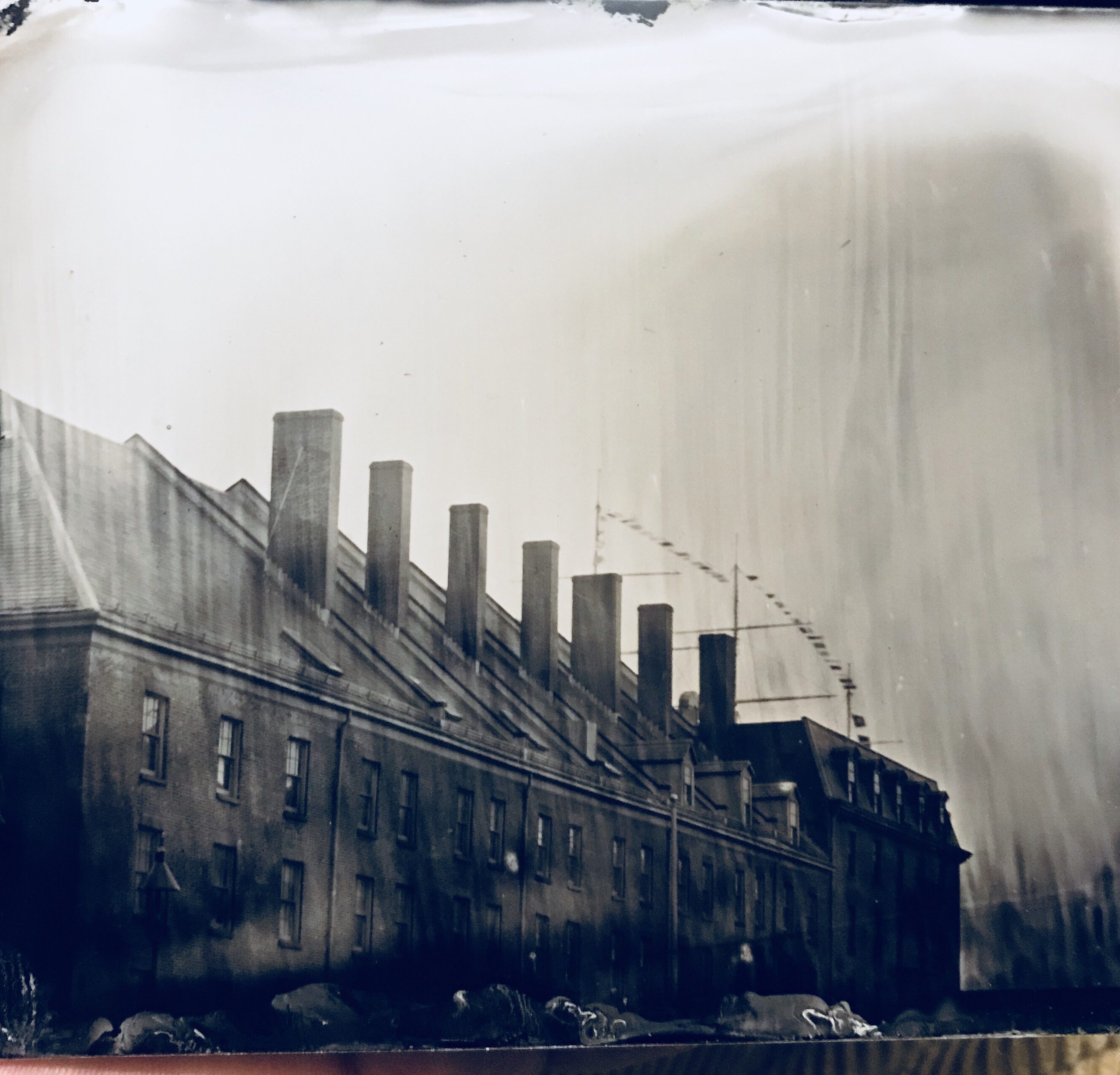
A quick breakfast, and then an early start to the day. I had a goal of pedaling up the Westside bicycle path with my wet plate gear, and setting my sights on the little red lighthouse under the George Washington bridge.
This time I was also hoping to shoot some 8×10 tintypes, and had mixed up enough silver nitrate bath to accommodate them. The weather looks to be perfect for the whole day.
The added gear, and larger plates made the trailer a little heavier than my last test ride. I attached my front panniers, and carried the two jugs of water forward. Though this did not lessen the weight of the rig, it did improve handling some.
A pleasant ride up to the lighthouse. Just over and hour to cover the twelve miles. Found a nice spot under a tree, and began setting up.
Before shooting 8×10, I started with 5×7. This would allow me to shoot test plates before going to a larger format. What I should do is adapt a holder that would take 2×2 plates for test shots. This would be more economical.
Once all the necessary gear was loaded into the box I figured I should rig up something to secure it in case a breeze picked up. Whilst walking to my bicycle for a length of line to anchor the box a gust blew my box over. Nothing damaged, but a full tank of silver bath was lost. An expensive lesson learned. 500ml of silver bath cost a little over $100. So glad it was not the 1000ml tank for the 8×10 plates!
I salvaged what little I could. Cleaned, and organized, and moved on with what I had. I would have to be content to shoot just 5×7 plates today.
Plate poured, bathed for four minutes, loaded and exposed for 10 seconds. Developed, fix, wash.
The exposure was. Will increase for the next plate. I repeated the whole process, but this time no image! I regrouped, looked a my supplies to make sure I was not making any simple errors like using fixer in place of developer.
All looked good. Try again. Little longer exposure. A faint image, but not what I was looking for. A few people were showing up now. The big camera always draws a crowd. I enjoy explaining the process to folks, and one young cyclist showed particular interest. I told him that I was having a little difficulty, but would be more than happy to walk him through the whole process.
I had enough colloidian for one more plate. With an audience now, I was keeping my fingers crossed. Pour, bath, load , expose, and develop. Once the plate was rinsed of developer it was ready for the fixer. When all goes well it is a very dramatic step. In the plate goes. A faint outline, but nothing worth showing. Obviously something was not right. I thanked my audience, and hoped to meet again when I had figured out what was going wrong.
I began the process of packing up my gear. I had hoped for a longer day shooting plates, but with the big spill, and other problems I was calling it a day.
Whilst securing the camera I gave the lens , and shutter a post shoot inspection. Cocked, and fired the shutter, and found that it was jammed. This was what was causing my problem. A faulty shutter.
Back home now. Will spend the day cleaning gear. Sunning the silver bath to remove impurities before filtering. Then work on the shutter to get it back in operation.
How would I rate the day? Excellent! Yes, despite all the problems I learned much today. Top of the list is to make sure the box is well secured before setting up with chemicals. That was an expensive lesson. Hope to get out again sometime next week for test ride #3.


The gear that stows in the box.

Moments before the box blew over!
 Webster’s Wet Plate
You must be logged in to post a comment.